Epilepsy surgery for children: our program and our results.
This page is for parents of a child whose seizures have not responded to medication. It explains how our pediatric epilepsy surgery program is organized, how we decide what to recommend, and what has happened to the children we have treated. The numbers below come from our own published results, and the papers are linked at the bottom so you can read them yourself.
We consider every child with drug-resistant epilepsy a candidate for some form of surgical therapy. That does not mean every child needs an operation. It means every child deserves a full evaluation by a team that can offer the complete range of options, from removing a seizure focus to implanting a device that responds to seizures as they start.
One program for children and adults.
Our pediatric program is part of a single epilepsy surgery program that treats patients of all ages. This matters for three reasons.
First, the surgeons who operate on children are the same surgeons who operate on adults. Your child's surgeon brings the case volume and experience of a full adult practice to the operating room.
Second, the newest techniques reach children faster. Recording from the thalamus with stereo EEG, and stimulating the thalamus with a responsive neurostimulator, were developed in our adult program and moved directly into the care of children.
Third, there is no handoff at 18. A child treated here stays with the same surgical team as an adult. The people who know your child's seizure network continue to manage it.
The team.
Dr. Mark Richardson is the primary pediatric epilepsy surgeon. Cases are typically booked jointly with Dr. Kristopher Kahle, Director of Pediatric Neurosurgery, so that both a functional neurosurgeon and a pediatric neurosurgeon are involved in every operation. The pediatric epileptologists are Dr. Lily Grossmann, Dr. Elizabeth Thiele, and Dr. Ronald Thibert. Every child is discussed at a multidisciplinary pediatric epilepsy surgery conference that includes pediatric epilepsy, functional neurosurgery, neuroradiology, and neuropsychology.
How we decide.
Every child begins with video EEG monitoring and a high resolution MRI, and most have neuropsychological testing. Depending on what those show, we add PET, MEG, functional MRI, 7 Tesla MRI, or tractography. When the seizure focus is still uncertain, or when we need to understand how seizures spread through the thalamus, we place stereo EEG electrodes, often including electrodes in the thalamus itself. The diagram below shows the path from first testing to a treatment decision.
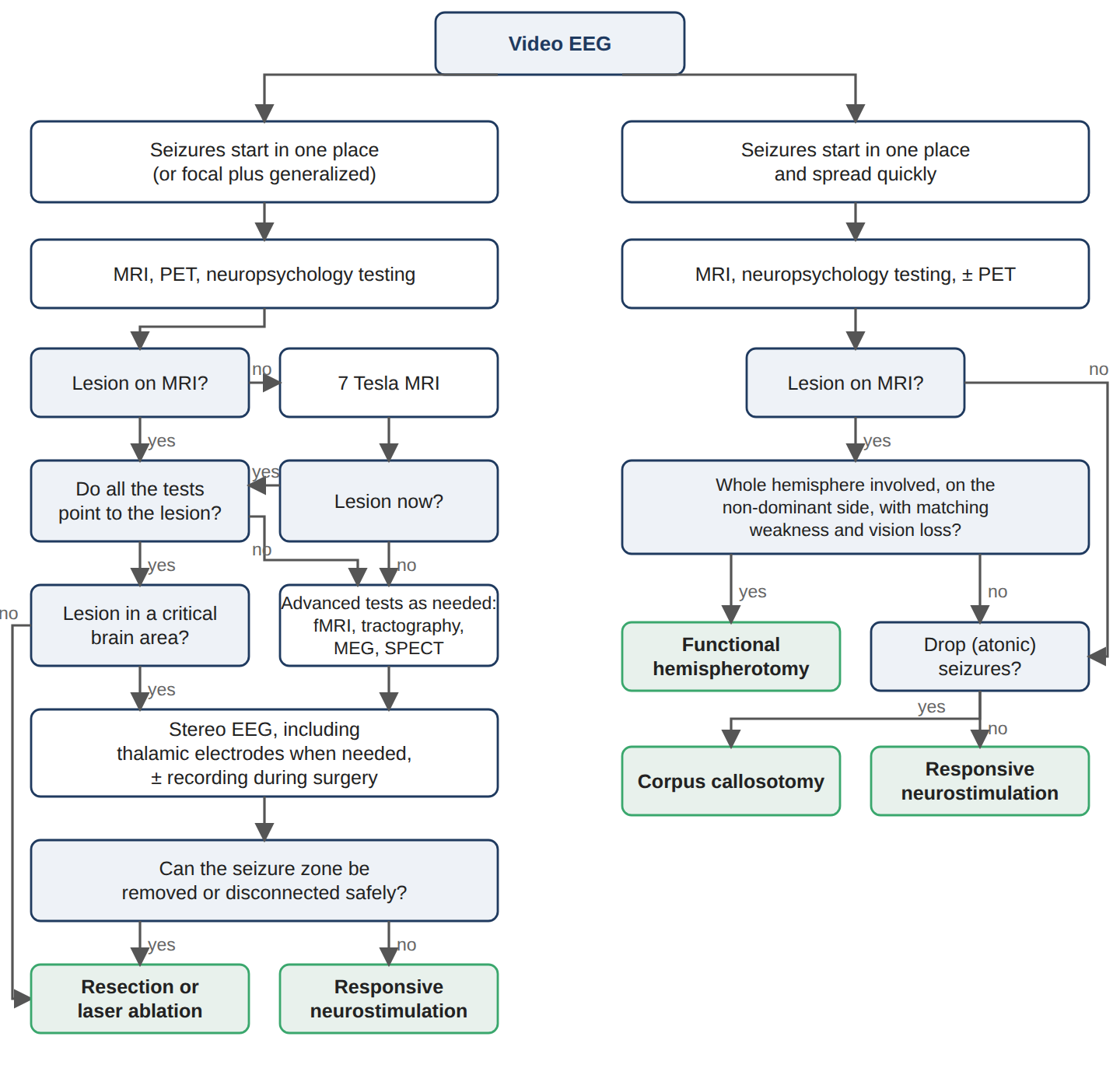
Redrawn in plain language from the decision workflow in McLaren et al., Epilepsia Open, 2026.
Two kinds of operation come out of this process. When the seizure focus can be removed or disconnected safely, we aim for a cure: resection, laser ablation, or hemispherotomy. When it cannot, or when seizures start in more than one place or across the whole brain, we aim to reduce seizures with responsive neurostimulation (RNS) or, for drop seizures, corpus callosotomy. Some children have both, for example a limited resection combined with RNS.
Who we treat.
Between February 2020 and April 2024 we performed 100 consecutive procedures in 62 children and young adults. Roughly a third were diagnostic stereo EEG and two thirds were treatment operations. Just over half of the children had focal epilepsy. The rest had multifocal, generalized, or combined epilepsy, groups that historically were not offered surgery at all. A third had no visible lesion on MRI. Outcomes did not differ between children with and without a lesion, or across epilepsy types, which is why we do not use a normal MRI as a reason to withhold an evaluation.
Results of surgery aimed at cure.
We recently reported on 33 children who had an operation intended to stop their seizures at MGH. 82 percent were seizure free at 12 months. Resection, the most common operation, had the highest rate. Children in this group also came off medication: the median reduction was two antiseizure medications by one year after surgery.
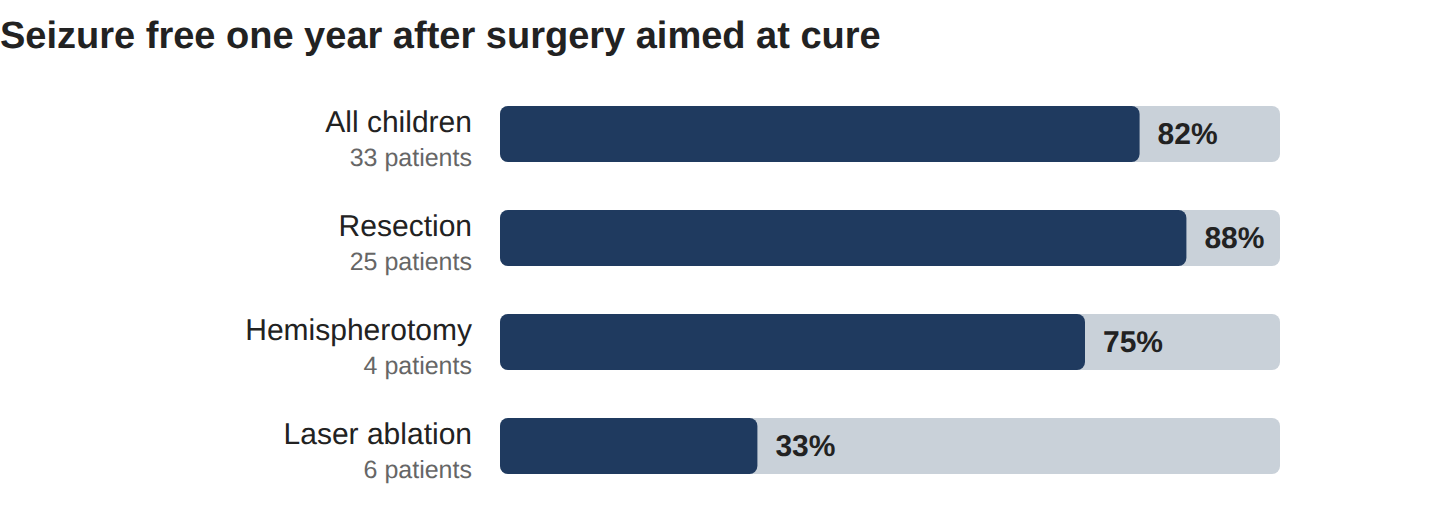
Engel class I at 12 months. Data from McLaren et al., Epilepsia Open, 2026.
Three of 64 treatment operations had a surgical complication, and none was permanent. Across 36 stereo EEG procedures, with an average of 12 electrodes per child, there were no serious adverse events.
Results of responsive neurostimulation.
We recently reported on 24 children and young adults who received an RNS device at MGH. 79 percent were responders at 12 months, meaning their seizures fell by at least half, and 38 percent were super responders, meaning seizures fell by more than 90 percent. The median reduction was 78 percent. A quarter were seizure free at one year. Response did not depend on whether the epilepsy was focal, multifocal, or generalized, or whether there was a lesion on MRI.
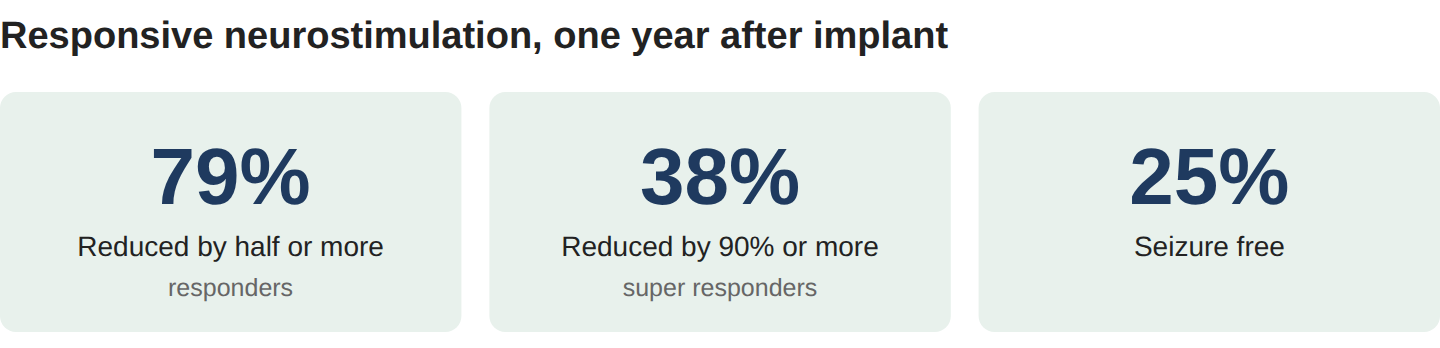
24 children and young adults. Data from McLaren et al., Epilepsia Open, 2026.
Ours was the first pediatric RNS program in New England and remains the largest. Our pediatric program published the outcomes of our initial 32 patients treated with RNS, including 27 children 18 and under, followed for a median of two years. Among those followed at least a year, 92 percent were responders at last follow up and the median seizure reduction was 91 percent. Improvement grows with time as the device is programmed to each child's seizure network. There were no surgical complications: no infections, no hemorrhages, and no neurological deficits. About four in ten patients had a side effect from stimulation, such as tingling or twitching, and every one resolved with a programming change. Two children needed an early battery replacement because of the high stimulation settings we use, and we discuss this with families before implantation.
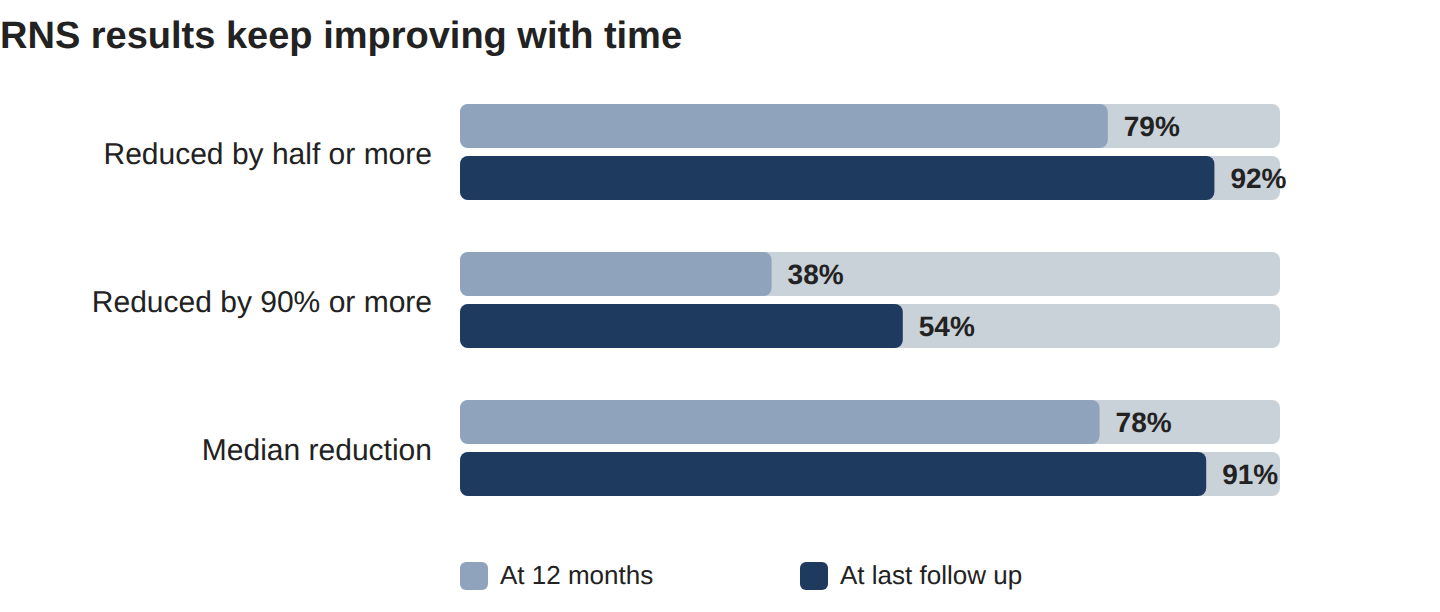
24 patients followed at least one year. Data from Geffrey et al., J Neurosurg Pediatr, 2026.
We also asked patients and parents how life had changed. Families reported improvement in physical activity and daily living, thinking and school, social life and mood, and in the seizures themselves. Every family reported improvement in at least one seizure related measure.
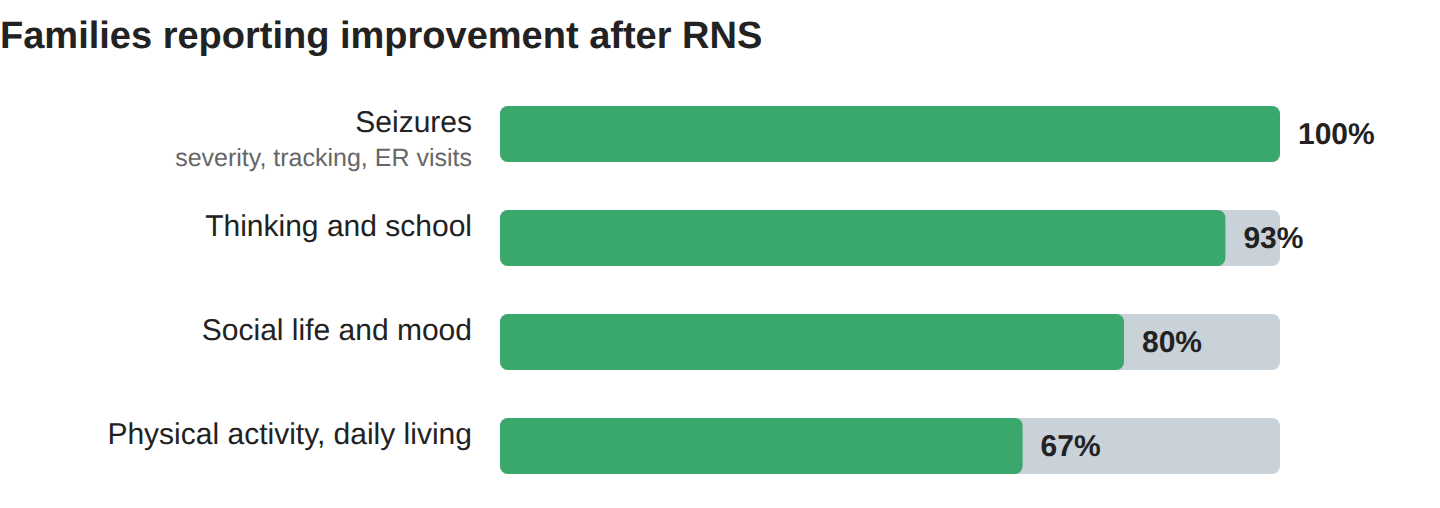
Children treated at least one year, 15 surveyed. Data from Geffrey et al., J Neurosurg Pediatr, 2026.
An example of how we work.
A six year old girl was transferred to us with continuous seizures affecting her right face and arm that had not stopped despite anesthesia and eight medications. The recommendation elsewhere had been hemispherotomy, which would have stopped the seizures at the cost of permanent weakness on one side and loss of half her vision. Her seizures came from two places: a frontal focus that could be removed and the motor cortex, which could not. We removed the frontal focus and placed RNS electrodes over the motor cortex, then increased stimulation rapidly over the following weeks. Her continuous seizures stopped after programming her device at the bedside over many days. She eventually came off multiple medications, returned to her baseline thinking and movement, and has remained seizure free for more than 17 months. We tell this story because it shows what a combined program makes possible: a tailored answer rather than the biggest operation.
Read the papers.
Expanding the scope of pediatric epilepsy surgery: access, indications, and outcomes in a modern cohort. McLaren, Muñoz, and colleagues. Epilepsia Open, 2026.
Seizure and quality of life outcomes following responsive neurostimulation treatment for drug-resistant epilepsy in children and young adults. Geffrey and colleagues. Journal of Neurosurgery: Pediatrics, 2026.
Emergent responsive neurostimulation in pediatric super-refractory epilepsia partialis continua. Hadar and colleagues. Annals of Clinical and Translational Neurology, 2024.